Mexican Free-Tailed Bats emerge from Bracken Cave, outside of San Antonio, TX. This cave is the spring/summer home for the largest colony of any mammal on earth, with over 15 million individuals. This emergence continues at this density for up to four hours after the babies are born mid-summer.
Recorded & Photographed May 9 / Posted May 18, 2018
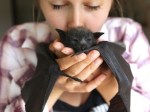
When my sister was very little she made a sign that said Happy Halloween. Only she didn’t know how to spell Halloween. So she wrote Happy The Bat instead. This is that bat.
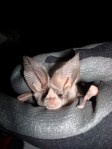
In today’s Bat Week post, we’re checking out the adorable “California Leaf-Nosed Bat.” The California leaf-nosed bat (Macrotus californicus) is a gray-furred, medium-sized bat, which has a leaf-shaped structure on its nose.
The ears are large (1.1-1.5 inches, 29-38 mm) and are joined near their base. Roosting leaf-nosed bats do not cluster in tight packs, as most other bat species. Total lifespan of California leaf-nosed bats is not known; however, one was recaptured after 15 years. California leaf-nosed bats do not migrate long distances nor do they hibernate.
Instead they maintain a year-round presence by roosting in a cave or mine that maintains a high temperature (greater than 82ºF or 28ºC); many of these caves are geothermally heated.
Edit: Thanks everyone for all the love 🙂 This post has gotten very popular.
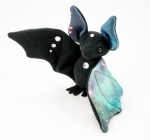
These bats are almost a year old now and sold a long time ago. I still do make the bats, but they do sell out quickly so if you’re interested I advise you follow my page and watch for updates.
These things are sooo cute and I HAD to share them. They combine my two main loves. Bats & Space!! Heed the creators word above if you want to purchase!
BATS roost in big groups in caves. Wrong! If you’re a Hardwicke’s woolly bat, you prefer to sleep in a more luxurious – and private – place.
Kerivoula hardwickii roosts inside tropical pitcher plants in Borneo. These carnivorous plants usually attract insects, but Nepenthes hemsleyana lacks the scents that others have, so few bugs are lured in. Instead,
it benefits from the faeces of this tiny bat, which provides more than a
third of its nitrogen and may be crucial to the plant’s survival.
“This is the only bat species that has ever been found roosting in pitchers,” says Caroline Regina Schöner, whose team discovered the bats
in 2009. “These bats managed to find a niche that no one else is
occupying."…


















 Fibromyangela